RGIPT–CHT MoU to Advance Energy Research, Industry Collaboration and Start-up Development
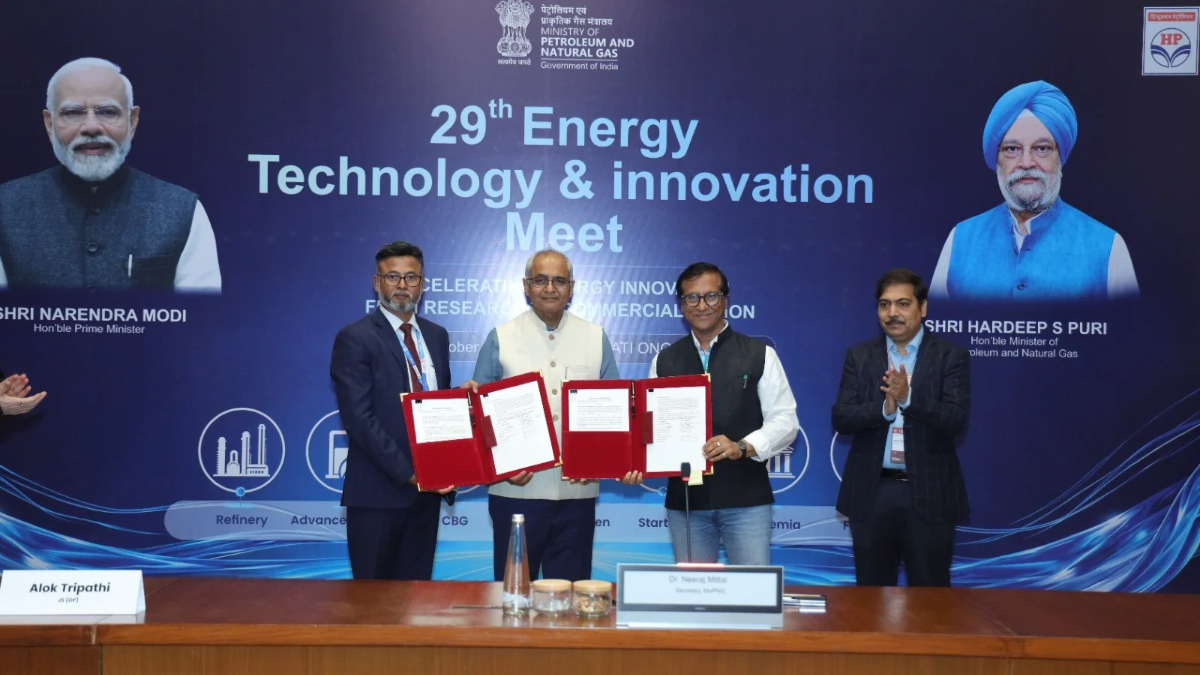
Prof. Harish Hirani, Director, RGIPT, with the Secretary, Ministry of Petroleum and Natural Gas (MoPNG), during the 29th ETM, GOA
Jais, Amethi (Uttar Pradesh) [India], November 2: The Rajiv Gandhi Institute of Petroleum Technology (RGIPT) has highlighted its recent collaboration with the Centre for High Technology (CHT) as an important step towards linking doctoral research and student innovation with practical challenges in the petroleum, petrochemical and energy sectors. The five-year Memorandum of Understanding (MoU), signed on 27 October 2026 during the Energy Technology Meet (ETM 2026) in Goa, was exchanged between Shri Sankar Gunasekaran, Executive Director, CHT, and Prof. Harish Hirani, Director, RGIPT, in the presence of Dr Neeraj Mittal, Secretary, Ministry of Petroleum and Natural Gas (MoPNG), and Shri Alok Tripathi, Joint Secretary, MoPNG.
Joint Ph.D. Fellowships to Address Industrial Challenges
A key component of the agreement is the proposed CHT–RGIPT Joint Ph.D. Research Fellowship Programme, which will support doctoral research on challenges identified by the petroleum, petrochemical and energy industries. Up to three scholars may be enrolled annually, with the possibility of increasing the intake to five, subject to the agreed provisions, and a maximum of 10 fellows may be supported at any given time. Selected scholars will receive a fellowship 25% higher than the prevailing CSIR/UGC-NET/GATE fellowship rates, along with other admissible benefits.
The scholars will work under the joint supervision of RGIPT faculty members and experts nominated by CHT or its industry partners. Research areas include green hydrogen, fuel cells, advanced batteries, corrosion engineering, carbon capture and utilisation, crude-to-chemicals, catalysts, biofuels, waste valorisation, digitalisation and energy efficiency. The programme aims to improve the practical relevance of doctoral research and accelerate the translation of scientific findings into useful technologies.
From Research Laboratories to Energy Start-ups
Prof. Harish Hirani, Director, RGIPT, emphasised the importance of encouraging doctoral scholars to pursue patents, prototype development, product creation and start-ups alongside academic publications. The MoU provides a framework to explore how promising research outcomes in its covered areas may progress from laboratory investigations to proof-of-concept validation, prototype development and, where commercially viable, technology-based enterprises.
Through engagement with MC² Foundation and related programmes, the collaboration will explore opportunities for innovation mentoring, sponsored research, technology development and commercialisation, subject to applicable conditions. With appropriate technical guidance and industry engagement, doctoral scholars may consider entrepreneurship alongside careers in academia, research and industry. Such research-led ventures could contribute to indigenous technology development, employment generation and India’s energy innovation ecosystem.
Prof. Hirani also indicated that future discussions may consider how product- and patent-oriented outcomes could be recognised in doctoral assessment. No changes to the existing Ph.D. requirements have been finalised. Dr. Arshad Aijaz, Dean, Academic Affairs, noted that the possibility of recognising patents, innovative products and commercially viable technologies as doctoral outcomes remains under deliberation and has not been adopted as academic policy.
Student Innovation: From Industrial Problems to Practical Solutions
Highlighting RGIPT’s Design and Innovation Project initiative, Prof. Hirani explained that student teams work on real-world industrial problems and develop potential solutions through project-based learning. Approximately 250 problem statements were identified, involving 115 students, with initial financial support of ₹10,000 per team. Promising projects may receive additional support and opportunities to pitch their ideas to incubation partners, helping promising concepts move towards practical applications and potential start-ups.
Dr. Milan Kumar, Dean of Research and Development, highlighted opportunities for innovation mentoring and prospective funding support through the MC² Foundation and related programmes, subject to their applicable conditions. The broader aim is to nurture a culture in which students and researchers are encouraged to identify problems, test ideas, develop prototypes and explore pathways to technology transfer and enterprise creation.
Testing Facilities, Sponsored Research and Industry Engagement
The MoU envisages the joint establishment of testing facilities at RGIPT campuses to address technological challenges faced by the petroleum and energy industries. The facilities are expected to strengthen experimental capabilities, support technology validation and enable collaborative research. Both organisations will explore long-term industry-sponsored research projects aligned with operational requirements and emerging technological needs.
RGIPT is also working to strengthen its central instrumentation facilities, improve equipment availability and maintenance, and broaden engagement with research institutions, including CSIR laboratories. These efforts are intended to expand access to scientific expertise and research facilities and help technologies progress beyond proof of concept towards validation, pilot-scale demonstration and potential industrial adoption.
Capacity Building and Energy Policy
RGIPT and CHT will jointly organise national and international training programmes in collaboration with Indian refineries. The programmes will cover petroleum refining, petrochemicals, asset integrity, process safety, green hydrogen, digital technologies, energy transition and sustainable energy systems, strengthening knowledge exchange between academic experts and industry professionals.
RGIPT will also participate in CHT’s Activity Committee Meetings to gain insights into operational challenges faced by refineries and identify opportunities for research-based solutions. The two organisations further plan to establish an energy think tank to support policy formulation and strategic thinking in the petroleum and energy sectors.
Strengthening India’s Energy Future
RGIPT is an Institution of National Importance under the Ministry of Petroleum and Natural Gas, engaged in education, research and technology development across conventional and emerging energy domains. CHT serves as a dedicated technology cell of the Ministry for the hydrocarbon sector.
By bringing together doctoral research, student innovation, industry expertise, testing infrastructure, specialised training and pathways for start-up development, the collaboration aims to strengthen the link between knowledge creation and practical application. The partnership is expected to promote indigenous technology development, support energy sustainability and create opportunities for young researchers to become innovators, technology developers, and entrepreneurs—contributing to India’s energy security, technological self-reliance, and sustainable energy transition.
If you object to the content of this press release, please notify us at pr.error.rectification@gmail.com. We will respond and rectify the situation within 24 hours.